
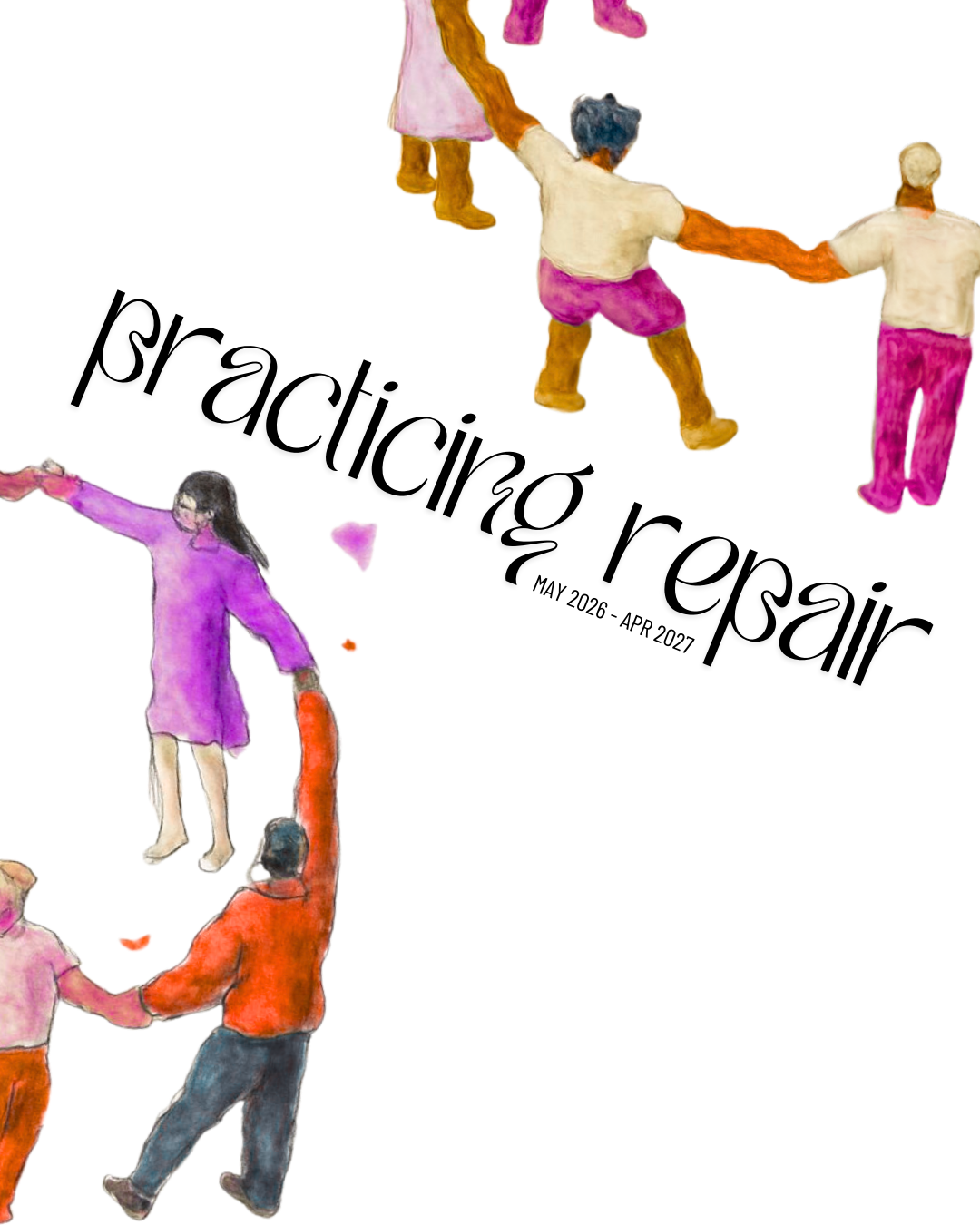
Practicing Repair is a 12-month committed learning space for people who are already trying, in small or large ways, to respond to conflict and harm in the communities they are part of.
Over the course of the year, a small group will come together regularly to build skills, share experiences, practice responses to harm, and learn from one another while exploring restorative and transformative justice approaches in the Indian context.
Learn more
Why this space exists
Over the last few years, our collective has been working alongside individuals, communities and organisations through moments of conflict, harm and systemic violence in India and beyond. Again and again, we’ve encountered how limited the available responses are.
The infrastructure needed to practice restorative and transformative justice in India is still quite thin. There are few consistent spaces where people can learn tools, share struggles, reflect on failures, or figure out how to practice this work in contexts that are often complex and evolving.
Practicing Repair is an attempt to build such a space.
A place where people already engaging with these questions can come together to learn, experiment and support one another. Over time, we hope this helps strengthen a network of practitioners rooted in their contexts who can hold processes of conflict and repair when communities look for alternatives.
What this community of practice offers
We imagine this space as:
Long-term: A sustained process over a year that allows relationships, trust and depth of learning to grow.
Committed and consistent: A group that shows up regularly, builds skills for responding to conflict and harm, creating a container where we can take risks, share challenges and hold each other accountable.
Collective: People bring their own questions, experiences and struggles into the space and learn from one another.
Experiential and practice-focused: We learn by doing - working through real situations, building facilitation skills and reflecting on what emerges.
By the end of the year, the intention is for the group to emerge as a community of practitioners who can continue supporting one another in this work.
Who is this for?
This community of practice is for people who are already trying to engage with conflict and harm in the spaces they inhabit.
This might include those who:
support conflict processes within organisations or movements
work in community or grassroots spaces
facilitate difficult conversations or accountability processes
are experimenting with restorative or transformative justice approaches
Some familiarity with these ideas is needed, and the space is best suited for people who can commit to being present throughout the year.
If you are completely new to restorative or transformative justice, this space may not be the right starting point - but we’re happy to share resources that might support your learning.
Schedule, Dates & Commitment
The community of practice runs from May 2026 to April 2027. The group will gather regularly in Bengaluru alongside monthly online conversations.
Opening gathering
May 2 & 3, 2026 (Bengaluru)
We begin the year with a two-day in-person gathering focused on building agreements, relationships, grounding ourselves in shared political commitments and setting the tone for the year ahead.
Monthly in-person gatherings
June 2026 – March 2027 | 10:30am – 4:30pm
First Sunday of each month in Bengaluru
These gatherings will be the core space for collective reflection, learning and practice.
Monthly online skill-shares
Once a month we will host a 1.5 hour online skill-share with experienced practitioners who will share perspectives and tools from their work. Dates will be shared with the group in advance and sessions will be recorded so participants can revisit them if needed.
Closing gathering
April 3 & 4, 2027 (Bengaluru)
We close the year with a two-day gathering to reflect on what has emerged through the process and what participants are taking forward into their work and communities.
Practice beyond the room
Participants will be encouraged to experiment with applying what they are learning in the spaces they inhabit and bring those experiences back to the group.
Overall commitment
Participants should expect to commit to:
Two 2-day in-person gatherings in Bengaluru at the beginning and end of the year
One full-day in-person gathering each month in Bengaluru
One 1.5 hour online skill-share each month with experienced practitioners
Occasional time for reflection or experimentation between gatherings
Be an informal community of support for each other after the year ends
Practical Details
Location: Bengaluru (exact location will be shared over email)
Group size: 15 people
Language: The primary language used in the space will be English, while recognising that people may move between languages informally during conversations.
Contribution (sliding scale): ₹6,000, ₹9,500, ₹12,500 (payment plan available)
Five full-scholarship spots are available.
Gathering Dates
May 2 & 3, 2026 - Opening gathering
June 7, 2026
July 5, 2026
August 2, 2026
September 6, 2026
October 4, 2026
October 31, 2026 (Saturday - note this is not on a Sunday)
December 6, 2026
January 3, 2027
February 7, 2027
March 7, 2027
April 3 & 4, 2027 – Closing gathering
Who We Are
Alternative Justice
Alternative Justice is a transnational collective of practitioners supporting people, organisations & movements in the work of conflict, harm and repair.
Dee
Dee (they/them) is a facilitator and practitioner of restorative and transformative justice based in India. They support individuals, communities, organisations, and movement spaces to navigate conflict, address harm, and build relationships rooted in care and accountability. Dee initiated Alternative Justice in 2020. Their practice has included facilitating restorative circles and reintegration processes with young people involved in the juvenile justice system in Bengaluru, supporting community responses to intimate partner harm and gender-based violence, and building infrastructures for conflict transformation and collective care within feminist organisations and movement networks in India and beyond.
Aki
Aki Krishnamurthy is an empowerment space holder, mover/dancer, experienced group facilitator, who centers an embodied approach to collective transformation towards social justice. She uses approaches like theatre of the oppressed, dance/movement and somatics to reflect on racism, gender relations, decolonization and transformative justice in various contexts (Germany, Colombia, Argentina, India). She is convinced that personal, social, and political change must be conceived by and with the body.
Ameya
Ameya (he/they) is a researcher based in Bengaluru working on policing, prisons and the justice system from an abolitionist and a transformative justice lens. He tries to engage with questions of power, violence and conflicts in progressive workspaces, within people's movements and in academia. He is also interested in working on the idea of chosen families, friendships and communities that challenge the hegemony of existing normative units (marriage, family, caste, other parochial and supremacist groupings) that the society and the state is built on and thinking of ways to create alternatives to this.
If you have questions about whether this space is right for you or any details we might have missed, feel free to write to us at alternativejusticein@gmail.com
To stay updated, join our WhatsApp community:
Or subscribe to our newsletter: